Day One Japan

Your first trip to Japan.

Know what to prepare before you fly, how to get through the ticket gate, and what to keep handy once you arrive.

Getting around

Do I need Suica, or can I tap my credit card?

Start with one rechargeable transit card per traveler. Suica, PASMO and ICOCA work across many participating train and bus networks. You can also tap an eligible contactless bank card on certain routes.

Suica, PASMO or ICOCA

Load money onto the card and use the transit IC reader. The fare comes out of your balance.

Contactless credit or debit card

Use a marked bank-card reader. Your card is charged for the ride. Check the operators on the whole route, including transfers.

Get a transit card. Pick up a physical Welcome Suica at Haneda Terminal 3’s Tokyo Monorail station or either Narita Airport rail station. It lasts 28 days from purchase, takes cash top-ups and has a nonrefundable balance. On a compatible iPhone or Apple Watch, you can add a supported transit card in Apple Wallet. JR East also offers Welcome Suica Mobile for iOS.

  • Tokyo and its airports. Tokyo Metro, Toei Subway and Keikyu offer bank-card tap-to-ride at participating gates. At Shinagawa, exit through a regular Keikyu gate and enter JR separately with a transit card or ticket. Use a transit card or ticket for JR East lines such as the Yamanote Line and for travel from Narita Airport. For Narita’s express trains, check the additional ticket requirements.
  • Through trains and IC areas. Use a transit IC card from the first gate if you will stay on a Tokyo Metro train as it continues onto JR East, such as from the Chiyoda Line onto the Jōban Line. Bank-card tap-to-ride is unavailable for that journey even if there is no gate between operators. For trips between separate transit IC areas, check the operator and buy a through ticket before boarding if it does not accept a single IC tap-in and tap-out.
  • Kyoto and Osaka. Use Suica, PASMO or ICOCA on Kyoto’s city buses and subway. In Osaka, eligible bank cards work on Osaka Metro’s subway and New Tram at dedicated readers.
  • Fukuoka. Eligible bank cards work at all Fukuoka City Subway stations, including the airport line. Use a transit card or ticket if your subway train continues onto JR’s Chikuhi Line.

At the gate. Tap in and out with the same card or device. A physical bank card and the same card in your phone count as different devices, and a bank card cannot be shared between riders. If you tapped a bank card at Tokyo Metro and rode beyond the coverage area, ask staff before you leave. Tokyo Metro says you may need to return to a supported station to close your entry record and settle its fare.

With children. Use a child IC card or child ticket where applicable. Tokyo Metro, Toei, Keikyu and Osaka Metro charge the adult fare for bank-card taps. Fukuoka City Subway can apply a child fare if staff set it before each entry.

Operator coverage checked .
What needs a separate train ticket?

Get a Shinkansen ticket for Kyoto, Shin-Osaka or Hakata, or check whether your rail pass covers the train. Smart EX lets you book the Tokaido–Sanyo Shinkansen and board with a QR ticket or a transit IC card assigned to the booking.

  • Changing from a JR train to the Shinkansen. If you use a Smart EX QR ticket, scan it at the Shinkansen transfer gate, then tap the transit IC card you used on the first leg. If you used a paper ticket for the first leg, insert it before scanning the QR. The first leg still has its own fare. Collect the printed seat information as you go through.
  • Narita Express and Skyliner. Buy the limited-express ticket for the train you choose. Both require the basic fare as well. Check whether it’s included in your purchase, especially if you plan to use an IC card for the basic fare.
  • Japan Rail Pass. Check for a covered train before paying separately. A nationwide pass holder needs a special supplement before boarding a Nozomi or Mizuho.
  • Traveling with a large suitcase. Add its length, width and height. For the Tokaido–Sanyo–Kyushu Shinkansen, luggage over 160 cm total and up to 250 cm needs an oversized baggage reservation. Select the baggage option when booking your seat.

Before you fly

What should I do before I fly?

Check whether you need a visa, decide how to complete your arrival forms, and save the details of your first night offline.

  1. Check your passport and visa requirements. Bring a valid passport. For a short tourist trip, check the visa rules for your nationality, passport type, and length of stay. The Japanese embassy or consulate for your place of residence can confirm which rules apply.
  2. Choose how to complete your arrival forms. Visit Japan Web is the optional official way to enter immigration and customs details online and display a QR code. You can also complete the paper forms on arrival.
  3. Check your medicines before packing. Look up each active ingredient and the quantity you will carry, even for medicine prescribed at home. Some medicines require advance permission. Amphetamine-based Adderall is prohibited. If your usual medicine is restricted, speak with your prescriber well before travel.
  4. Save your first-night details. Keep your hotel’s name, address in Japanese, phone number, and check-in deadline in a note you can open without data. If you arrive late, save your last train or bus and an airport hotel backup.

How do I get online when I land?

Check your carrier’s Japan roaming plan first. A travel eSIM is an option if your exact phone model supports it and your phone is unlocked.

  • Set up a data plan before you leave. Check when the plan starts and follow your provider’s installation instructions. If you need regular calls or texts, check what the plan includes before buying.
  • Choose a fallback. An unlocked phone with a SIM slot can use a compatible travel SIM. A pocket Wi-Fi rental can suit several devices or a carrier-locked phone. Major airports have free terminal Wi-Fi if you need to get connected on arrival.
  • Save maps and your route on Wi-Fi. Download map areas where your app supports it and save screenshots of your first train route and hotel directions. In Google Maps, live transit and walking directions require an internet connection.

What should I book in advance?

Choose where to stay, then book your first hotel and any experience you’d rearrange your trip for. Leave ordinary subway trips and flexible sightseeing for the day itself.

  • Hotel and intercity travel. Book lodging early for Golden Week, Obon and the New Year holidays. Check the room’s guest and bed count, total with any local tax, cancellation deadline and late check-in policy. Reserve a train seat when you need a specific departure, seats together, or oversized luggage space.
  • Timed tickets. Look up the venue’s official sales calendar in Japan time. Check whether you need a reservation for your chosen attraction, restaurant or tour.
  • Arrival day. Give yourself room for immigration and delayed flights before committing to a fixed departure or timed ticket. Save confirmations and cancellation terms on your phone.

While you’re in Japan

What do I do with my suitcase?

Use a station locker for a few hours, or send your suitcase ahead if you’re changing cities.

  • Between checkout and your train: Look for a locker or a staffed storage counter at the station you’ll leave from. Large lockers can fill up. Check the pickup deadline and save a photo of the locker number and location.
  • Between hotels: Ask your current hotel about forwarding and check that the next hotel can accept your bag. Confirm the delivery date and cutoff before handing it over. Keep your passport, medication and anything you’ll need overnight with you.
  • Taking the Shinkansen: Measure your bag and check the oversized baggage rules before you choose a seat.

Will I need cash, and how do I explain what I can eat?

Bring a payment card and some yen. If you have dietary requirements, save a short explanation in Japanese that you can show offline.

  • Paying: Cards work at many shops and restaurants. Keep yen for smaller businesses and places that only take cash. You can withdraw yen with many overseas cards at Seven Bank ATMs.
  • Vegetarian or vegan meals: Ask about the broth and sauces as well as the main ingredients. Dashi can contain fish even in a vegetable dish. For a set menu or a ryokan meal, contact the venue before booking.
  • Food allergies: Show staff the specific allergens in Japanese before ordering. Ask about shared fryers and utensils if cross-contact matters for you. If the kitchen can’t confirm the ingredients or preparation, choose another option.
  • Packaged food: Japan requires declarations for some allergens and recommends them for others, including sesame and soy. Read the full ingredient list and ask the maker about any unclear ingredients or cross-contact. If you can’t verify a food you need to avoid, choose something else. For unpackaged food, ask staff directly.

What should I eat at a Japanese convenience store?

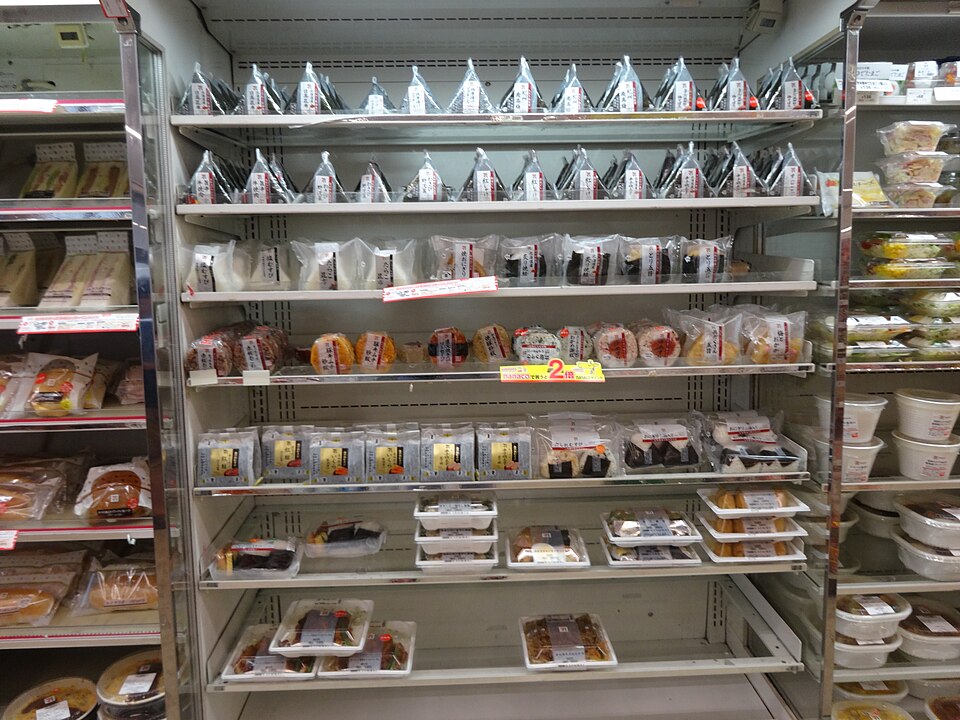
Shelves of wrapped onigiri and prepared meals in a Japanese convenience store
amanderson2 · CC BY 2.0 · Cropped

A konbini is handy for an early train or a late hotel check-in. Try one of these combinations, depending on what’s on the shelf.

  • Quick breakfast: Pick up a chilled egg sandwich (たまごサンド) and coffee (コーヒー). Add a cup of cut fruit if you want something extra.
  • Hot lunch: Look for curry and rice (カレーライス) or a boxed meal (弁当) in the chilled section. If there’s a microwave at the counter, point to the meal and ask 温めてもらえますか? (Atatamete moraemasu ka?, “Could you heat this up?”).
  • Late-night bite: Try a salmon rice ball (鮭おにぎり) and cup miso soup (カップみそ汁). The soup needs hot water. Check for a kettle at your hotel or ask at the store. This combination works for an early breakfast too.

Soup, rice-ball seasonings and sauces can contain fish stock. The allergen box may omit ingredients for which separate allergen declarations are optional. Read the full ingredient list and see the dietary needs and food allergies guide if anything is unclear.

Who do I call in an emergency?

  • 119 for an ambulance or fire. Say what happened and give the address or a nearby landmark.
  • 110 for police. Call for urgent help after a crime or traffic accident.
  • 050-3816-2787 for the Japan Visitor Hotline. JNTO offers help in English, Chinese and Korean around the clock.

If your phone can’t place a call, ask hotel staff, station staff or someone nearby to call for you. Before you leave, install the Japan Tourism Agency’s Safety tips app for earthquake, tsunami and weather alerts in English.

What will help me feel less out of place?

On trains, join the platform queue, let people off first, and step aside before checking your phone. Keep calls off the train and bags clear of the doors.

Tipping is generally unnecessary at restaurants, taxis and hotels. A quick sumimasen (“excuse me”) helps when you need someone’s attention.